STEM toys sit at the intersection of two strong purchasing motives: children want an enjoyable activity, and adults want the purchase to support useful skills. That combination continues to attract parents, gift buyers, schools, and retailers. Ahrefs estimates approximately 5,800 monthly U.S. searches for “STEM toys” and 4,000 for “educational toys,” with global volumes of about 12,000 and 18,000 respectively.
Industry signals reinforce the opportunity. In its 2026 trends announcement, The Toy Association reported that 78 percent of surveyed U.S. parents wanted more toys that help children develop skills such as creativity and problem solving. The same report highlighted open-ended kits, modular construction, and design-led creative toys. For retail buyers, the lesson is useful: a successful educational range should make learning visible through play rather than covering an ordinary product with academic language.
A Strong STEM Toy Starts with a Real Play Problem
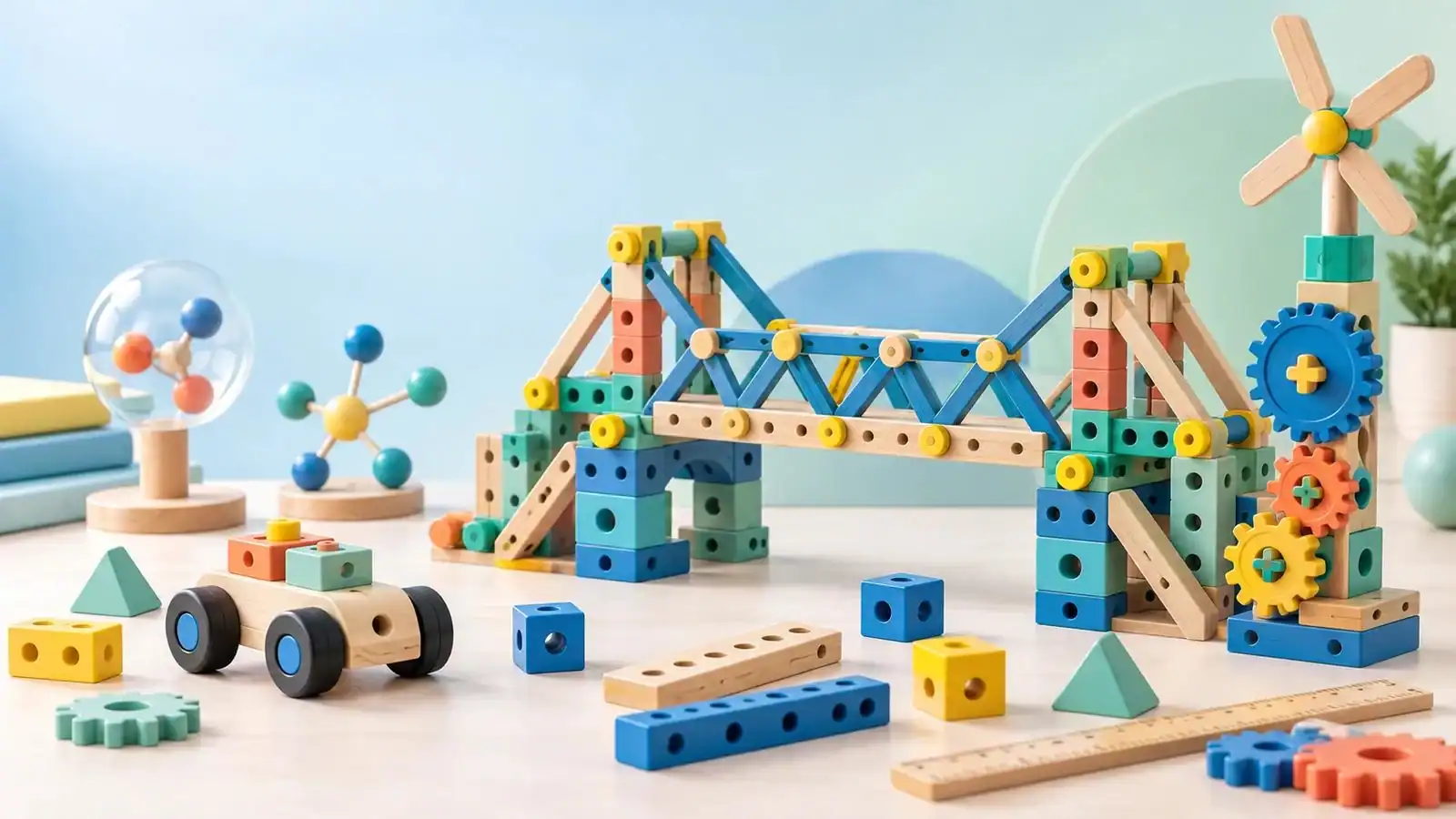
The best STEM products invite children to investigate a question or complete a meaningful challenge. How can a bridge hold more weight? What happens when gears change size? Can a child mix colors to match a card, build a moving model, or design a path that guides an object to a goal?
The question gives the activity direction, while experimentation gives it replay value. A kit with only one correct result may provide a satisfying first build but little reason to return. A product that supports several designs, difficulty levels, or self-created challenges can stay relevant longer.
Buyers should ask a simple question during product review: what does the child actually do? If the answer is specific—compare, predict, build, test, adjust, and try again—the educational benefit is easier to trust. If the answer depends mostly on reading facts from a card, the product may be educational content but offer a weaker play experience.
Match the Challenge to the Age Group
Age labels alone do not make a learning toy suitable. The number and size of components, reading level, required hand strength, attention span, assembly precision, and complexity of the goal should all fit the intended user.
For younger children, effective products often use large components, simple cause and effect, matching, sorting, color recognition, and short activities with quick feedback. For early primary ages, buyers can introduce basic construction, patterns, measurement, simple experiments, and guided creative tasks. Older children may enjoy multi-stage builds, detailed models, logic challenges, and opportunities to modify a design.
Good instructions serve both the child and the adult. Visual steps reduce language barriers and help children work independently. Short explanations can connect the activity to a concept without interrupting play. A “try this next” section can extend an experiment using the same components.
Look for Open-Ended Value
Open-ended play is especially important in 2026 because it combines learning with self-expression. One set of parts might support a guided first project and then invite original designs. A craft-based STEM kit might teach a mechanism while leaving color, form, and decoration to the child. A tabletop challenge might include prepared tasks plus blank cards for players to invent their own.
This structure also improves the commercial story. Retailers can show several outcomes in product photography, short-form video, and in-store demonstrations. Parents can see that the kit is more than a one-time activity, while children can imagine making something personal.
When comparing samples, calculate value through possible play sessions, not only the number of pieces. Fifty repetitive parts may offer less value than twenty carefully selected parts that combine in multiple ways. Extra components should introduce a new function, challenge, or creative choice.
Packaging Must Explain the Learning Benefit Quickly
STEM packaging often fails in one of two ways. It can look too academic, making the product feel like homework, or it can make broad claims without showing what happens inside. Strong packaging leads with the finished action: build it, test it, race it, mix it, solve it, or redesign it.
The front panel should identify the core activity, recommended age, and main contents. Supporting panels can show several projects, the steps in the play loop, and the skills practiced. Clear component photography helps buyers and consumers judge value. If adult help is required, say so rather than creating disappointment after purchase.
Retailers planning international distribution should reserve enough space for required warnings, importer details, instructions, and market-specific languages. Packaging engineering should begin early because changes to box dimensions, windows, trays, or component layout can affect freight cost and product protection.
Safety and Quality Still Come First
The word “educational” does not create an exception from toy safety rules. A STEM kit may introduce specific risks through small parts, projectiles, magnets, batteries, liquids, powders, accessible edges, or heat. Requirements depend on the product, age grade, and destination market.
For toys sold in the United States, importers should review the applicable sections of ASTM F963 as incorporated under federal rules, along with other children’s product requirements. Toys designed primarily for children age 12 or younger generally need third-party testing by a CPSC-accepted laboratory and a Children’s Product Certificate. The buyer should confirm that reports match the exact design, materials, components, and production version.
Quality control should also cover the learning experience. Do parts fit consistently? Are measurements accurate enough for the experiment to work? Do printed cards match the components? Can children follow the illustrated steps? A technically safe toy can still generate returns if the promised project cannot be completed reliably.
A Practical Sourcing Checklist
Ask potential manufacturing partners the following questions:
- Which STEM or creative skill is central to the product?
- What does the child build, test, or discover during play?
- Can the set support more than one project or difficulty level?
- How was the recommended age determined?
- Which standards and tests apply to every component?
- Can instructions and packaging be localized for each market?
- Which colors, tools, cards, molds, and packaging elements are customizable?
- How are component counts, fit, printing accuracy, and finished-kit function inspected?
Build a Range, Not a Collection of Unrelated Kits
A coherent assortment helps shoppers understand where to begin and what to buy next. Retailers can organize products by age, activity type, skill, or challenge level. Consistent packaging can connect entry-level sets, larger gift kits, and refill or expansion products. Seasonal themes and licensed designs can add variety without abandoning the core learning promise.
FI’s stationery and creative learning range provides a foundation for OEM and ODM development. A buyer can define the target age, activity, price, package format, and destination market, then refine the contents and presentation with the manufacturing team. Contact FI to discuss a new educational toy or custom creative-learning program.